
Managing money is a big job for businesses. A good financial manager can make this easier. This post will show how they help keep a company's finances healthy and strong. Keep reading to learn more!
What is a Financial Manager?
A financial manager carries a lot of weight in any organization. They take care of the company's finances, making sure it stays healthy and grows. This includes managing cash flow, preparing financial statements, and keeping an eye on the market to guide investment decisions.
They work closely with senior managers to plan for the future and make smart choices that boost the company's financial stability.
Financial managers are key players in helping businesses maximize profitability and ensure long-term growth.
Their job involves analyzing data to produce reports on how well the business is doing financially. They also develop budgets to control spending and increase profits. Alongside this, they monitor how money moves in and out of the business daily.
It’s their responsibility to comply with laws on handling finances, advising companies on investments, risk management, and planning for economic ups and downs.
Key Roles and Responsibilities of a Financial Manager
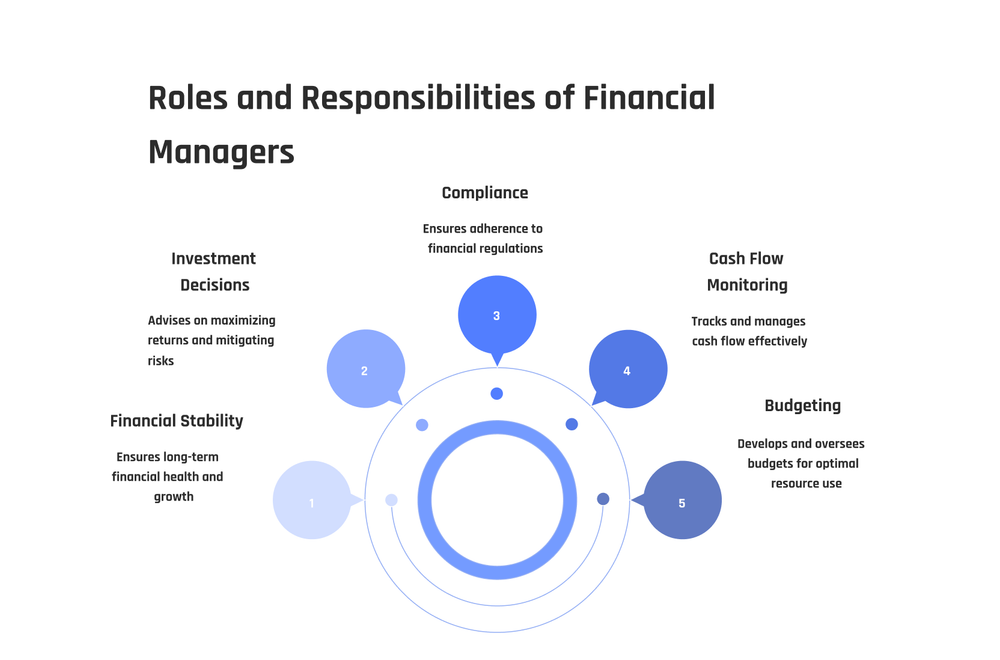
Financial managers prepare and analyze financial reports. They develop and oversee budgets, monitor cash flow, ensure compliance with financial regulations, and advise on investment decisions.
Preparing and analyzing financial reports
Preparing and analyzing financial reports is a key job for financial managers. They take care of all the numbers related to a company's money matters. These reports help them understand how well the business is doing.
Financial managers look at sales, costs, and profits to make sure everything adds up right. They also check if the company can pay its bills on time and plan for future expenses.
They use these reports to suggest ways to improve financial health. This might involve finding areas where the company can spend less or make more money. Analysis of financial data helps in making smart decisions about where to invest funds too.
Developing and overseeing budgets
Financial managers shape and manage budgets. Their primary responsibility is to make sure the company's finances are used well to achieve its objectives.
This includes identifying the financial needs of different business segments, such as new initiatives or routine operations. Collaborating closely with other departments, financial managers establish and monitor budgets with precision.
By doing so, they prevent excessive expenditure and ensure the availability of funds for vital operations.
They also respond to financial conditions of the company by amending budgets as required. If a section incurs excessive costs, financial managers strategize the resolution without affecting the company's collective performance.
Subsequently, their attention shifts to monitoring cash flow and maintaining a watchful eye on the organization's financial status.
Efficient budgeting supports companies through financial obstacles by distributing resources judiciously.
Monitoring cash flow and financial health
Financial managers monitor the cash flow and financial health of an organization. They track the movement of money in and out of the company to make sure there is enough cash to cover expenses and invest in growth opportunities.
By analyzing financial reports, they can pinpoint any areas of concern and take necessary actions to maintain a healthy cash flow. Financial managers also keep a keen eye on the overall financial health of the company, which involves assessing its profitability, liquidity, and solvency.
This vigilance helps them make informed decisions regarding investments, managing risks, and ensuring the long-term financial stability of the organization.
Ensuring compliance with financial regulations
Financial managers keep their organizations compliant with financial regulations to avoid legal and financial consequences. That means staying current with tax laws, market regulations, and industry standards so the company's financial activities meet every requirement.
They need to monitor changes in government policies that may impact the organization's finances, making adjustments as necessary to ensure adherence to new rules and regulations. In addition, they work closely with legal and compliance teams within the organization to guarantee that all financial practices abide by relevant laws and guidelines while mitigating potential risks associated with non-compliance.
Regulatory frameworks keep changing, so finance managers must pay close attention to legal requirements on credit limits, business continuity plans, and operational expenses, all while limiting risks tied to market fluctuations or interest rates.
Advising on investment decisions
Financial managers also advise on investment decisions. They evaluate potential investment opportunities and recommend strategies to maximize returns while limiting risks.
Financial managers draw on their expertise in risk management and strategic planning to guide organizations toward sound investment choices. Their financial analysis skills let them assess market trends and identify good prospects for growing the company's assets.
They also weigh in on portfolio management, helping businesses allocate resources for profit-maximizing outcomes.
Financial managers read market conditions carefully, backing their financial management goals with thorough data analysis and a deep understanding of industry trends.
Their ability to build customized investment strategies helps organizations make informed decisions as financial conditions change.
Core Skills Required for Financial Managers
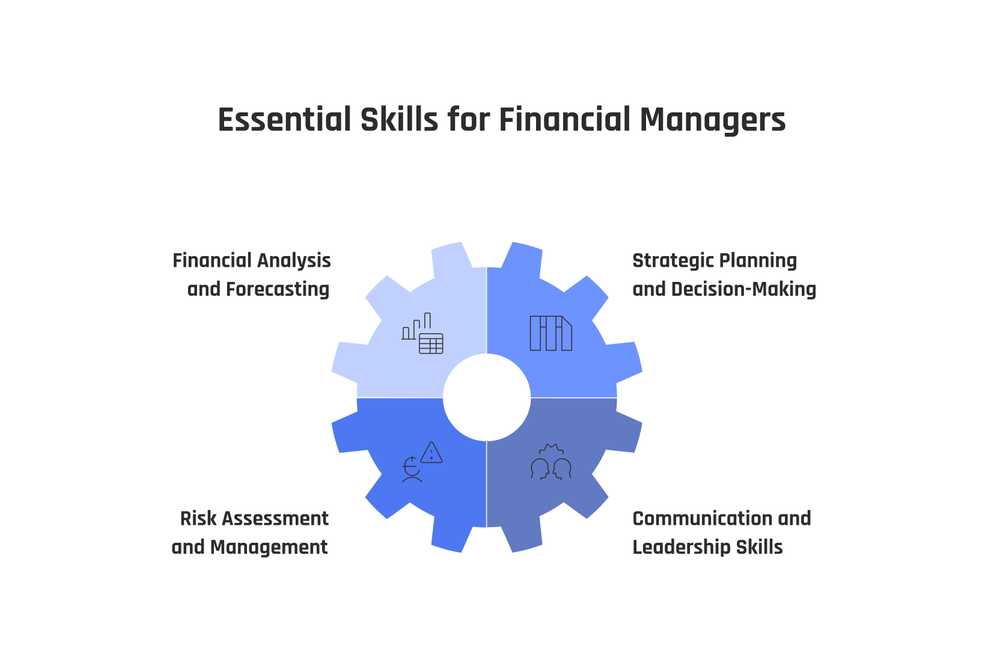
Financial managers need to excel in financial analysis and forecasting, as well as strategic planning and decision-making. They are also required to possess strong risk assessment and management abilities, along with effective communication and leadership skills.
Financial analysis and forecasting
Financial analysis means examining a company's financial performance using techniques like ratio analysis and cash flow analysis.
This helps evaluate the company's profitability, efficiency, and liquidity. Forecasting means predicting future financial trends based on historical data and market conditions.
Financial managers use these forecasts to make well-informed decisions about investments, budgets, and overall financial planning.
Financial analysis and forecasting also surface potential risks or opportunities for the company. Analyzing past trends helps project future scenarios accurately.
That supports sound strategic planning and decision-making around the company's financial resources. It also helps evaluate investment options for maximizing profits while limiting risks and staying within regulatory compliance.
Strategic planning and decision-making
After analyzing financial data and forecasting future trends, financial managers must engage in strategic planning and decision-making. This involves crafting long-term financial goals for the company and implementing strategies to achieve them.
The process also includes major decisions on investments, capital budgeting, and the optimal capital structure for the organization. Financial managers constantly evaluate market risks as economic conditions change.
They steer the company by making sound financial decisions that fit its overall business objectives.
Strategic planning and decision-making directly affect the company's financial health, profitability, and growth trajectory. Financial managers need to balance risk while working to improve profitability through prudent decisions.
Their decisions must also comply with relevant regulations and contribute positively to the company's working capital management.
Risk assessment and management
Financial managers assess and manage risks to protect the financial health of their organization. They identify potential risks, analyze their potential impact, and develop strategies to mitigate them.
That means closely monitoring market fluctuations, regulatory changes, and operational risks to make informed decisions that balance risk and profitability. Financial managers apply their risk management expertise through customized strategies that support the company's financial stability while dealing with challenges such as credit risk, investment management, and cash flow.
They also strengthen risk assessment by implementing strong financial controls, conducting thorough financial ratio analysis, and creating detailed business activity reports.
The work spans corporate finance, investment management, and government compliance, each with its own risks to manage.
With a median annual wage of $134,180 as reported by the U.S. Bureau of Labor Statistics in 2020, these roles demand a thorough understanding of both finance and strategic planning to address their challenges.
Communication and leadership skills
Financial managers need strong communication and leadership skills to lead finance teams and convey complex financial information. These skills come into play when presenting financial reports, advising on investment decisions, and collaborating with other departments.
They also matter for guiding finance teams, implementing strategies, and mitigating risks. Financial managers must be able to explain financial data clearly to stakeholders such as company executives or shareholders.
These skills help them take charge of challenging situations like market fluctuations and regulatory changes. Financial managers with strong communication abilities can clearly articulate the rationale behind their investment decisions or budget allocations, gaining trust from both internal and external stakeholders.
Strong leadership steers finance teams through the complications of risk management or corporate finance and keeps everyone working toward the firm's overall goal of maintaining financial health.
Areas of Expertise for Financial Managers
Financial managers specialize in corporate finance, risk management, investment and portfolio management, and government and regulatory compliance. Their expertise carries organizations through complicated financial regulations and shifting market conditions.
Corporate finance
Financial managers specializing in corporate finance are responsible for overseeing a company's financial activities. They manage the company's investment strategies and financial performance, ensuring that the business is on track to meet its financial goals.
Corporate finance managers analyze data to make strategic decisions regarding investments, mergers, and acquisitions while also evaluating the company's capital structure and managing its cash flow.
They also maximize shareholder value by determining how best to allocate resources within the organization.
Corporate finance managers must manage risk well. They assess potential risks associated with different investments or projects and develop strategies to mitigate them.
Their expertise in financial analysis and forecasting equips them to inform critical decisions that affect a company's overall financial health.
Risk management
In risk management, financial managers make sure the organization identifies and mitigates potential financial risks. They oversee strategies to minimize exposure to uncertain or adverse events that could hurt the company's financial health.
This includes analyzing market trends, assessing investment risks, and implementing measures to safeguard the company's assets and investments. With their expertise in risk assessment and management, financial managers strive to create strong frameworks that protect the organization from potential financial challenges while maximizing profitability.
Financial conditions keep shifting, and financial managers rely on skills like risk analysis, credit evaluation, and strategic planning to keep up. They anticipate potential threats to the organization's finances through careful risk assessments and implement customized risk management strategies that protect against unforeseen challenges while meeting regulatory requirements.
Investment and portfolio management
Financial managers specializing in investment and portfolio management are responsible for overseeing the organization's investment strategies. They analyze market trends, assess risk, and make decisions about where to invest the company's money.
This role requires a keen understanding of financial markets and various investment vehicles such as mutual funds, stocks, and bonds. The goal is to maximize returns while managing risks effectively.
Strong analytical skills and in-depth knowledge of different investment options carry professionals far in this area.
Precision matters, since these professionals need to stay current on shifting market dynamics so investments line up with organizational objectives and hit the desired outcomes.
They work closely with financial analysts to gather data insights that support their strategic decisions. They manage current investments with care and design customized strategies for future growth opportunities in the market, both of which contribute to the company's overall financial health.
Government and regulatory compliance
Financial managers keep organizations compliant with government regulations. They stay updated on financial laws and guidelines to protect their organizations from legal issues.
That means carefully reviewing, interpreting, and implementing financial regulations so all activities meet the set standards. Failure to comply could lead to hefty fines or legal action.
They also work closely with internal and external auditors to confirm adherence while devising strategies that fit these regulatory requirements.
Compliance work involves complex rules like the Sarbanes-Oxley Act (SOX) and the Dodd-Frank Wall Street Reform and Consumer Protection Act.
Financial managers also need to consider industry-specific regulations such as those set by the Securities and Exchange Commission (SEC) for financial institutions or healthcare compliances for insurance companies.
How to Become a Financial Manager
To become a financial manager, acquire the necessary education, gain relevant work experience, and pursue certifications like the CFA or CPA.
Education requirements
Financial managers typically need at least a bachelor's degree in finance, accounting, economics, or business administration. Some employers may prefer candidates with a master's degree for advanced roles.
Courses in financial analysis, risk management, and investments build the necessary expertise. Aspiring financial managers can also pursue certifications such as Chartered Financial Analyst (CFA) or Certified Public Accountant (CPA) to strengthen their credentials and stand out in a competitive job market.
Relevant work experience matters too. That often means starting in entry-level positions like financial analyst or accountant before advancing to managerial roles.
Hands-on experience gives a deeper understanding of financial operations and puts theoretical knowledge to practical use. Building strong analytical and leadership skills during these formative years pays off later as a financial manager.
Gaining relevant work experience
After meeting the education requirements, aspiring financial managers need relevant work experience. This could mean internships or entry-level roles in finance and accounting departments.
While working, individuals should focus on preparing financial statements, managing investments, and developing cash management skills. They can also seek out positions in credit or insurance management to learn about risk assessment and mitigation strategies firsthand.
Hands-on experience hones analytical and detail-oriented abilities and builds a strong foundation for future leadership roles in financial management, learned by working through real-world complications.
It's a chance to apply the strategies learned in school while getting firsthand experience in managerial decision-making.
Pursuing certifications like CFA or CPA
Certifications like the CFA or CPA strengthen your credentials considerably. Certified Public Accountant (CPA) certification suits roles that emphasize accounting and tax preparation.
It demonstrates expertise in auditing, business structure analysis, and compliance with taxation regulations, all core parts of the financial manager's role. Chartered Financial Analyst (CFA) certification emphasizes investment management skills, the basis for strategic investment decisions as a financial manager.
These certifications build knowledge and verify expertise in the areas that matter most to the role.
Challenges Faced by Financial Managers
Financial managers face the challenge of adapting to market fluctuations and balancing risk with profitability, all while working within complex regulations and making strategic decisions as conditions shift.
Adapting to market fluctuations
Financial managers are entrusted with the task of adjusting to market fluctuations. They must stay updated on economic conditions and their impact on investments, budgets, and financial strategies.
When market conditions shift, financial managers need to swiftly assess the situation and adjust investment portfolios or budget allocations accordingly in order to maintain financial health.
Market uncertainty is a constant, so this adaptability protects assets and supports long-term financial goals.
Financial managers also use risk management strategies to weather market fluctuations. Diversifying investments across different asset classes softens the impact of market volatility.
Staying informed about industry trends and monitoring economic indicators lets them anticipate marketplace changes early. That adaptability keeps their decisions well-informed even through unpredictable market shifts.
Balancing risk and profitability
Financial managers are tasked with the critical role of balancing risk and profitability. They have to carefully evaluate investment opportunities while taking into account potential uncertainties involved.
This involves using financial analysis and forecasting skills to identify the most effective investment strategies that offer high returns while minimizing potential downsides. In this domain, risk managers work closely with financial managers to execute strategies that effectively mitigate risks without compromising profitability.
It's a precise and forward-thinking endeavor.
This strategic equilibrium requires careful attention to detail in analyzing market trends, comprehending economic indicators, and assessing the impact of regulatory changes on investments.
A strong understanding of these factors enables financial managers to make informed decisions that result in optimal outcomes for their organizations' financial well-being.
Navigating complex regulations
Financial managers encounter the challenge of carefully navigating a complex network of regulations that oversee the financial industry. These regulations stem from various sources, including federal and state governments, as well as industry-specific regulators such as the Securities and Exchange Commission (SEC) or the Financial Industry Regulatory Authority (FINRA).
Financial managers must ensure compliance with these regulations to avoid legal issues and maintain the confidence of investors and stakeholders. This involves staying updated on changing regulatory requirements, understanding their implications for their organization’s operations, and making necessary changes to policies and procedures in response.
Financial managers also deal with international regulatory standards, adding another layer of complexity. For example, they may need to work through tax treaties between different countries if their organization operates globally.
Adhering to these diverse regulations takes careful attention to detail and an ability to interpret complex legal language as the rules keep changing.
Financial managers safeguard their organizations against the financial risks that come with non-compliance.
By building an understanding of complex regulations into day-to-day operations and holding compliance standards across all aspects of finance, financial managers shield their organizations from the consequences of getting it wrong.
Conclusion
Financial managers contribute a great deal to the financial well-being and success of an organization. Their responsibilities include preparing and analyzing financial reports, creating budgets, monitoring cash flow, and providing guidance on investment choices.
Strong analytical, strategic planning, and communication skills drive success in this field. The role keeps changing and presents real challenges, but it rewards people who thrive in the finance industry.
FAQs
1. What is the overall goal of a financial manager?
The main task of a financial manager is to manage investments, prepare financial statements and implement strategies that will increase the value and profitability of their organization.
2. Can you explain some job duties for government financial managers?
Government financial managers work on budgeting, spending and tax-related issues. They also prepare detailed reports to ensure public funds are used effectively.
3. How does the role of credit managers differ from insurance managers in finance?
Credit managers oversee an organization's credit business while insurance managers handle risk management tasks including setting up company-wide insurance policies.
4. Are detail-oriented skills important for a financial advisor or manager?
Yes, being detail-oriented helps greatly as they need to analyze complex financial data, make investment decisions and ensure compliance with laws.