
Choosing the right path to become a successful financial advisor can be tricky.
A bachelor's degree in finance or business is often needed. This blog post will guide you through essential qualifications, from education to skills, for success in advising on financial goals and investments.
Educational Requirements
To succeed as a financial advisor, obtaining a bachelor's degree in finance, economics, or business is essential. Advanced degrees can also contribute to career growth and opportunities for professional development.
Bachelor's degree in finance, economics, or business
A bachelor's degree in finance, economics, or business is a key step for anyone looking to become a financial advisor. This education gives you the basic knowledge needed to understand financial markets, investment opportunities, and how to create effective financial strategies for clients.
You learn about different types of investments like mutual funds and securities. It also covers important areas like tax laws and risk management.
Having this degree shows potential clients that you know your stuff. It prepares you for further certifications and licenses required in the financial industry. Most firms hiring financial advisors expect at least this level of education.
So, if you're thinking about a career in providing personal financial advice or managing investment portfolios, start with getting a business degree in one of these fields.
Advanced degrees for career growth
Getting a master's degree can help financial advisors move up in their careers. Some go for an MBA or a Master's in Finance to learn about business, management, and advanced financial planning.
These degrees make advisors more skilled. They can then handle bigger clients and complex investment situations.
Mastering finance goes beyond basic degrees; it demands continual learning and specialization.
Courses from the American College of Financial Services also offer special studies. Here, advisors can get Chartered Financial Consultant (ChFC) designations. This shows they know a lot about insurance, estate planning, and retirement saving.
With these qualifications, advisors stand out and can do better work for their clients.
Licensing and Certifications
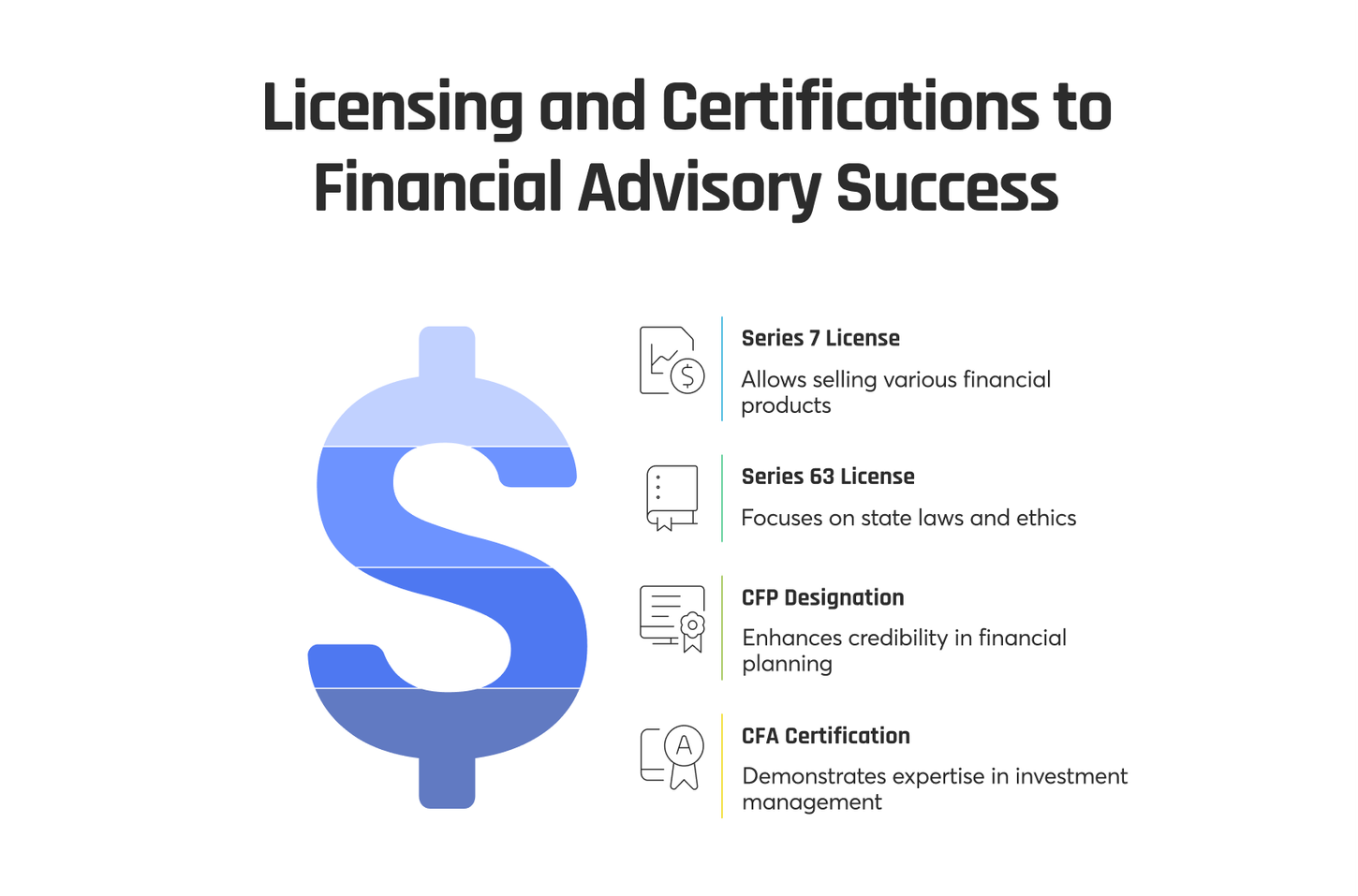
To become a successful financial advisor, obtaining licensing and certifications is essential. Meeting the requirements for Series 7 and Series 63 licenses, as well as achieving designations such as Certified Financial Planner (CFP) and Chartered Financial Analyst (CFA), paves the way for professional growth in this field.
Series 7 and Series 63 licenses
The Series 7 license is key for financial advisors. It allows them to sell almost all types of financial products. To get it, one must pass a tough exam. This test covers many topics about trading, customer accounts, and regulations.
Financial professionals also need the Series 63 license to work in most states. This license focuses on state laws and ethics requirements. Getting this means passing another exam that tests knowledge of these specific areas.
Certified Financial Planner (CFP) designation
Beyond the Series 7 and Series 63 licenses, the Certified Financial Planner (CFP) designation is a major milestone for financial advisors. The CFP certification requires candidates to meet educational criteria, pass a comprehensive exam, acquire relevant work experience in the financial planning field, and adhere to ethical standards set by the CFP Board.
With over 88,000 CFP professionals in the United States alone, holding this designation adds credibility and demonstrates expertise in areas such as retirement planning, estate planning, tax management strategies, and investment management.
As of June 2021, there were more than 3 million people working globally in finance-related occupations, with a projected job growth rate of about five percent until 2029, so demand for qualified financial planners who hold certifications like the CFP keeps rising.
The Certified Financial Planner (CFP) designation upholds a high standard for competence and ethics within the financial planning industry.
Chartered Financial Analyst (CFA) certification
The Chartered Financial Analyst (CFA) certification is another highly regarded credential for financial advisors. This globally recognized qualification goes deep into investment management and analysis, which makes it well suited to those advising on financial investments and managing clients' portfolios.
Many successful financial advisors hold this certification to demonstrate their expertise in investment planning and understanding complex investment products.
The CFA program covers a broad range of topics such as accounting, economics, ethics, and professional standards, providing candidates with a comprehensive skill set to address various aspects of financial advisory work.
Over 150,000 professionals worldwide have attained the designation, and it suits those who want more than standard accreditation. A CFA charter can also open doors to career advancement and networking opportunities at large firms or in private practice.
Key Technical Skills
Technical skills underpin a financial advisor's success: financial planning and investment knowledge, risk assessment and management, and tax planning expertise.
These skills are what make comprehensive, effective financial advice possible.
Financial planning and investment knowledge
Financial advisors need solid financial planning and investment knowledge. They must grasp the essentials of the securities industry, offer tax guidance, and hold the required licenses.
Advisors should know how to run their business and have sales experience, which helps with client acquisition. Keeping up with regulations and market trends lets them manage potential risks and improve their clients' financial outcomes.
Expertise in tax planning, risk assessment, and management forms the foundation of a successful career and lets advisors tailor advice to changing market conditions.
Proficiency with current financial analysis software gives advisors an additional edge on top of professional experience.
Risk assessment and management
Financial advisors must comprehend risk assessment and management to evaluate potential risks linked with investment opportunities. That means keeping up with market trends and regulations so their recommendations for client portfolios rest on good information.
For instance, understanding investment types like variable annuities helps advisors accurately assess the associated risks. Detailed risk assessment improves client portfolios and builds industry credibility, which attracts new clients.
Tax planning expertise
Financial advisors must possess tax planning expertise to assist clients in minimizing tax obligations and optimizing financial plans. Comprehensive knowledge of the tax code, encompassing deductions and credits, is essential for delivering holistic financial guidance.
Advisors should integrate investment strategies with tax-efficient methods for retirement planning, estate management, and wealth transfer. By including tax planning in their services, financial advisors can provide personalized solutions that align with clients' long-term financial objectives and maximize savings opportunities.
Advisors also need to stay informed about changing tax regulations and emerging trends. That lets them work through complex tax laws while staying compliant and improving overall returns for client portfolios through strategic tax planning.
Essential Soft Skills
Soft skills matter as much as technical ones for financial advisors: communication, empathy, and problem-solving top the list.
Strong communication and interpersonal skills
Financial advisors need strong communication and interpersonal skills to engage with clients. In client meetings, active listening and empathetic communication give you a thorough understanding of client needs and concerns.
Clear communication also lets you explain complex financial concepts to clients, which builds trust and understanding.
Making connections through networking matters too. These skills help you acquire new clients and nurture lasting relationships with existing ones, forming a solid client base.
The day-to-day work often involves answering questions about licensing requirements or offering tax advice, all of which takes solid verbal and written communication.
Empathy and active listening
Financial advisors need strong interpersonal skills, including empathy and active listening. These skills help you understand clients' needs and concerns, build rapport, and form real relationships.
For example, when providing tax advice or conducting business administration, the ability to effectively listen to clients' financial goals and show understanding of their challenges can lead to customized solutions that align with their specific circumstances.
Clients want more than financial guidance. They want an advisor they can trust who genuinely understands their individual situations, and these soft skills are how you show them that.
Active listening is equally important since it enables financial advisors to understand clients' complex financial preferences and provide appropriate recommendations aligned with those expectations.
By bringing empathy and active listening into client interactions, certified financial planner (CFP) professionals can work through complicated situations and deliver personalized financial advice that fits each client's needs.
Analytical thinking and problem-solving
Financial advisors must also excel at analytical thinking and problem-solving. Analytical skills let advisors assess complex financial data, identify patterns, and make strategic decisions.
Problem-solving matters just as much, since it lets advisors tackle the varied challenges clients bring, such as investment choices or tax planning. Finance keeps changing, and honing these skills keeps advisors able to handle new challenges and build tailored solutions for their clients' needs.
When conducting business within the financial industry regulatory authority framework, solid analytical thinking and problem-solving support a successful career path for any aspiring or established financial advisor.
Business Development Skills
Build your network and establish strong relationships with clients. Master sales techniques to acquire new clients and grow your business.
Networking and relationship building
Financial advisors need networking and relationship building skills to expand their client base. Connections with potential clients, other professionals, and industry leaders drive success in the financial advisory field.
Professional networks, industry events, and social media all help build a strong client network.
Sustaining positive relationships with existing clients through regular communication and personalized service keeps clients around. Nurturing these relationships bolsters a financial advisor's reputation and brings new clients through word-of-mouth referrals.
Good networking and relationship building carry a financial advisor's career a long way.
Sales and client acquisition strategies
To attract clients, financial advisors must know how to sell. Build a strong network through events, referrals, and professional organizations.
Advisors should use their technical expertise to demonstrate value to potential clients through personalized financial plans and tax advice. Many advisors find success in cultivating long-term relationships by providing exceptional service and seeking learning opportunities that allow them to stay updated on market trends and regulations.
Answering questions with empathy and a deep understanding of the client's needs wins new business. A communication style grounded in analytical thinking builds trust and shows real knowledge of finance.
With these methods, many financial advisors grow their clientele while maintaining a high standard of service.
Lifelong Learning and Adaptability
Financial advisors have to stay updated on regulations and market trends. Adopting new technology keeps them relevant as the industry changes.
Staying updated on regulations and market trends
Financial advisors must stay updated on regulations and market trends to provide the best advice. Regulations often change, impacting how financial advisors work and provide tax advice.
For example, in 2020, the SEC amended the "accredited investor" definition, allowing more investors to participate in private markets. Market trends also affect advising strategies; when interest rates change, it can influence investment recommendations.
Advisors who hold a Certified Financial Planner (CFP) designation are required to complete continuing education courses related to ethics and regulations every two years. Keeping up-to-date with these requirements ensures that financial advisors are well-informed about any changes affecting their profession.
Financial advisors should actively seek out information about new regulations and market trends through reputable sources such as industry publications or professional development seminars.
Embracing technological advancements
Financial advisors need to keep up with technology. Bringing it into their practices lets them streamline operations, improve the client experience, and stay competitive.
Financial planning software lets advisors give more accurate and efficient advice tailored to their clients' needs. Digital marketing strategies help them reach a wider audience and attract potential clients, more and more of whom look for financial services online.
Digital tools make advisory services more efficient and show clients an advisor keeps current with how preferences and markets change.
Conclusion
Becoming a successful financial advisor requires the right blend of education, licenses, and skills. Many financial advisors begin with a bachelor's degree in finance or related fields.
Advanced degrees can pave the way for career growth and specialization.
Licensing exams such as Series 7 and Series 63 are necessary to conduct business and sell insurance products. Certifications such as Certified Financial Planner (CFP) or Chartered Financial Analyst (CFA) demonstrate expertise and reliability.
Financial advisors also need strong technical skills: a solid understanding of financial planning, investment knowledge, risk assessment and management, and tax planning proficiency.
FAQs
1. What are the essential qualifications for becoming a financial advisor?
To become a successful financial advisor, one must pass multiple licensing exams and ideally hold certified financial planner (CFP) status. This profession also requires certain skills such as strong communication, analytical thinking, and problem-solving.
2. Do most financial advisors need to sell insurance?
Yes, in order to conduct business effectively, many financial advisors choose to sell insurance products as part of their services. Therefore, they often require additional qualifications or licenses related specifically to insurance.
3. How does one get the Certified Financial Planner (CFP) qualification?
The CFP is a recognized professional standard for most financial advisors. To obtain it, one must meet specific education requirements and pass a comprehensive multiple-choice test that covers various aspects of finance.
4. Are there other important skills needed beyond formal qualifications for success in this role?
Yes. Beyond formal educational requirements and passing the licensing exam, soft skills like clear communication with clients and ethical decision-making matter a great deal for success as a financial advisor.