
Many people want to manage their own business in the financial industry.
One fact about this field is that independent financial advisors have more control over their work life. This guide shows you how to become an ifa, step by step.
Increased flexibility and control
Working as an independent financial advisor offers more control over your career. You decide on the clients you want to work with and the services you provide. This means you can focus on areas that match your expertise, like risk management or investment strategies.
You're also in charge of setting your schedule. This flexibility lets you balance work with personal life better.
Being an independent advisor means being your own boss and making decisions that align directly with your professional goals and values.
You also get to choose the technology and tools that best support your business needs. Whether it's for managing client relationships or analyzing financial products, having control over these choices helps improve service quality.
Plus, running your own firm allows for direct communication with clients, building stronger trust and a solid client base.
Potential for higher income
Being an independent financial advisor often leads to a higher income than working within an institution. You determine your own fees and pick the services you provide. A larger share of your earnings stays with you instead of being shared with a bigger company.
For advisors who oversee investments, income is typically based on the volume of assets under their management. More assets under management usually means higher income.
Many advisors succeed by concentrating on particular sectors or providing distinct services, such as retirement planning or guidance on mutual funds. That kind of specialty can draw more clients who are prepared to pay for professional advice in certain fields.
Strong connections with present clients also lead to recommendations and new business without extra marketing spend.
Licensing and Certification Requirements
To become an independent financial advisor, you must pass the Series 65 Exam and earn a Certified Financial Planner (CFP) certification. These credentials are required for providing comprehensive financial advice to clients and staying compliant with regulations.
Series 65 Exam
The Series 65 exam is a must for anyone wanting to be an independent financial advisor. This test checks your knowledge about providing investment advice and managing clients' funds.
It is designed by the Financial Industry Regulatory Authority (FINRA). You need to pass this test to get a license as an Investment Advisor. The exam has multiple choice questions on laws, regulations, and various types of investments.
Studying for the Series 65 takes time and effort. You don't need a sponsor from a company or any specific work experience to take it. However, preparing well increases your chance of passing.
Once you pass, you can legally give financial advice in the securities industry. This step is key in becoming an independent advisor who helps clients achieve their financial goals.
Certified Financial Planner (CFP) certification
The Certified Financial Planner (CFP) certification is a key requirement for independent financial advisors. It covers areas like investment planning, retirement and estate planning, tax strategies, insurance, and employee benefits, which is what makes it the standard for comprehensive financial advice.
With financial markets and regulations getting more complex, this certification demonstrates a high level of expertise and professionalism. CFP professionals have seen an average income increase of 30% after obtaining the certification.
The CFP certification carries increasing weight in a competitive financial advisory market.
Steps to Becoming an Independent Financial Advisor
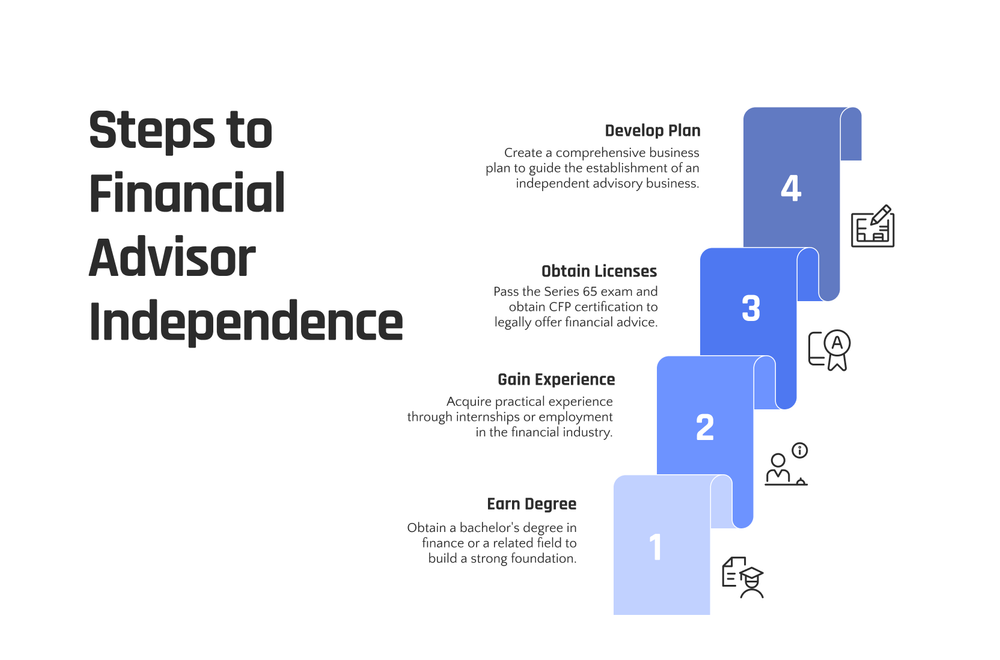
To become an independent financial advisor, you need to earn a bachelor's degree in finance or a related field and gain experience through internships or employment. You'll also need to obtain required licenses and certifications and develop a business plan.
Earn a bachelor's degree in finance or a related field
To become an independent financial advisor, you should have a bachelor's degree in finance or a related field. This education provides the foundation for understanding investment products, managing risk, and providing financial advice to clients.
Common certifications such as the Series 65 Exam and Certified Financial Planner (CFP) certification also require a strong educational background in finance. A bachelor's degree can also strengthen your credibility with potential clients and support services.
Becoming an independent financial advisor demands proficiency in financial analysis and an understanding of investment opportunities. A bachelor's degree gives individuals the knowledge base to provide personalized financial advice and to handle the essentials of the securities industry.
Gain experience through internships or employment
After completing a bachelor's degree in finance or a related field, get experience through internships or employment. This practical exposure shows you the day-to-day operations of the financial services industry and sharpens the skills you'll need for giving financial advice.
Working under experienced professionals teaches you about managing risk, building client relationships, and the finer points of securities and investments.
It also gives you a chance to network within the industry and see different types of clients and financial products up close.
The firsthand experience from internships or employment builds knowledge and demonstrates your commitment and capability to potential employers or future clients.
If you're considering becoming an independent investment advisor, seek out varied experiences. They build the business judgment and readiness you'll need to run your own advisory practice.
Obtain required licenses and certifications
To become an independent financial advisor, you need to acquire the required licenses and certifications. This usually involves passing the Series 65 exam and obtaining the Certified Financial Planner (CFP) certification.
The Series 65 exam permits you to offer investment advice, while the CFP certification demonstrates your competence in financial planning. These qualifications are required to legally offer financial advice and services to clients within the securities industry.
Develop a business plan
A business plan comes before opening the doors of an independent financial advisory business. First, outline your target market, services offered, and financial projections to attract potential investors or lenders.
Next, consider the costs associated with setting up your business such as office space, technology tools, and initial marketing expenses. This plan becomes your roadmap through the critical early stages of establishing your independent financial advisory business.
Afterwards, research competitors in your area and identify what sets you apart. Shape your marketing strategy around attracting new clients while retaining current ones by making your value proposition clear.
Selecting the Right Custodian
When choosing a custodian for independent advisors, several factors can affect your business, for better or worse. To learn more about why the custodian choice matters and how it can benefit your independent financial advisory business, read on.
Importance of a custodian for independent advisors
Choosing the right custodian matters a great deal for independent advisors. A custodian provides the infrastructure and support needed to execute trades, process paperwork, and maintain compliance with regulations.
They also safeguard client assets and provide reporting tools. When selecting a custodian, weigh factors like the range of investment offerings, technology integration capabilities, and overall support.
A good custodian should offer a wide array of investment products, like securities industry essentials (SIE) or variable annuities, alongside strong technology for managing clients' portfolios efficiently.
Also make sure the chosen custodian fits your business model and offers competitive pricing. Those two factors shape how well you can serve your clients and how much room you have to grow.
Factors to consider when choosing a custodian
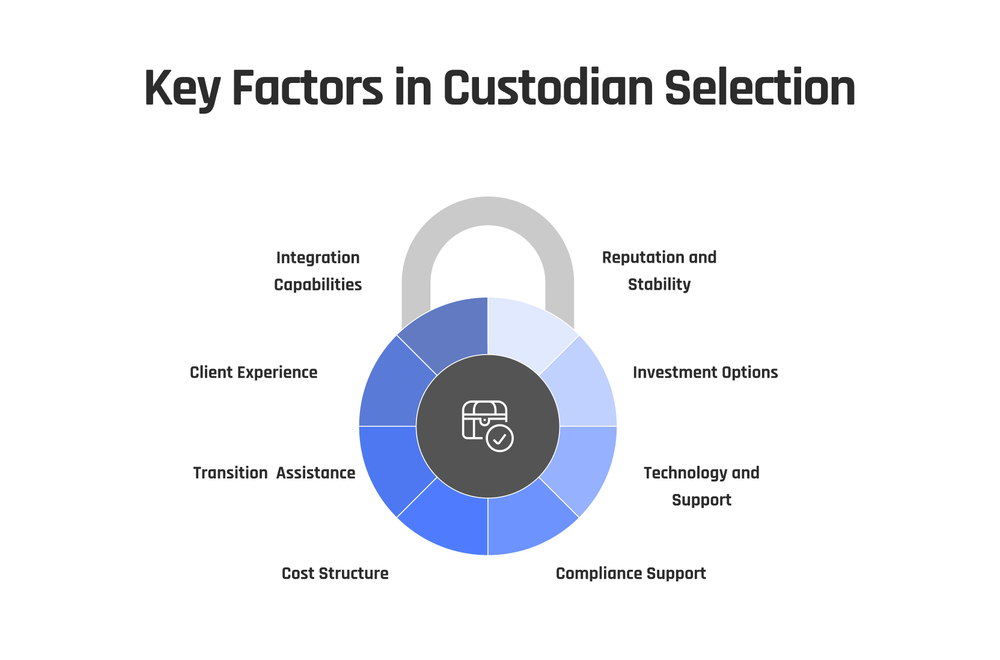
When selecting a custodian for your independent financial advisory business, weigh the following factors:
-
Reputation and Stability: Make sure the custodian has a strong reputation and financial stability to safeguard your clients' assets.
-
Range of Investment Options: Seek a custodian offering diverse investment alternatives to meet the needs of your clients and allow for flexibility in managing their portfolios.
-
Technology and Support: Assess the custodian's technology platform and support services against your business requirements and how much they'd improve your operations.
-
Compliance and Regulatory Support: Select a custodian that provides solid compliance support to help you stay aligned with industry regulations and ethical standards.
-
Cost Structure: Consider the cost structure of the custodian, including fees, transaction costs, and any additional charges, so it fits your business model while providing value to your clients.
-
Transition Assistance: Seek a custodian that offers smooth transition support when transferring client accounts, keeping disruption to a minimum.
-
Client Experience: Evaluate how the custodian's platform and services affect the client's experience, including reporting capabilities and accessibility.
-
Integration Capabilities: Check that the custodian's systems work smoothly with your existing tools and technology stack so your advisory practice runs efficiently.
Building and Retaining a Client Base
Develop a marketing strategy and build strong client relationships to grow and keep a loyal client base. Read more about how to grow your clientele as an independent financial advisor.
Developing a marketing strategy
A marketing strategy is how an independent financial advisor attracts and retains clients. Use digital marketing tools like social media and email campaigns to reach potential clients.
Creating educational content on personal finance topics can position you as an expert in the field, helping to build trust with your audience. Networking with other professionals, such as attorneys or accountants, can also lead to referrals for new clients.
Lastly, consider attending industry events or hosting workshops to connect with individuals seeking financial advice.
For an independent financial advisor, a strong marketing strategy combines digital tools like social media and email campaigns with educational content and networking with professionals in related fields.
Attending industry events or hosting workshops can help broaden your client base.
Building strong client relationships
Strong client relationships start with clear communication and understanding. Actively listen to clients' financial goals and concerns, then offer personalized advice aligned with their needs.
Providing regular updates on market trends and investment performance keeps clients informed and shows that you are actively managing their portfolios. Transparent, ethical practices are the foundation of long-term client loyalty.
Exceptional customer service can set you apart from other advisors.
Stay connected with your current clients by regularly checking in and offering educational resources or workshops that align with their financial interests.
Do not underestimate referral business. Satisfied clients can be a reliable source of new leads for your practice, and they cost nothing to acquire.
Time invested in client relationships improves client satisfaction and shows up in your business's bottom line.
Managing Your Independent Financial Advisory Business
Manage your independent financial advisory business efficiently with the right tools and technology. Compliance with regulations and ethical standards is just as important. Read on for more.
Tools and technology for efficiency
To run an efficient independent financial advisory business, digital tools and technology are a requirement. These tools include customer relationship management (CRM) software for organizing client data and interactions.
Financial planning software helps you build investment strategies customized to individual client objectives. Automated marketing platforms can also simplify client communication and lead generation.
Put these tools together and your operations run smoothly, your service improves, and you stay within industry regulations.
Staying compliant with regulations and ethical standards
Beyond tools and technology, staying compliant with regulations and ethical standards is a constant responsibility for independent financial advisors. That means following the rules set by governing bodies such as the SEC and FINRA.
As an independent financial advisor, obtaining the necessary licenses and certifications is required. This includes passing the Series 65 exam and securing a Certified Financial Planner (CFP) certification, which carries its own ethical standard.
Compliance with these regulations keeps you legally allowed to provide personalized investment advice, and it builds confidence with clients. Upholding ethical standards reinforces your commitment to acting in your client's best interest while keeping all financial dealings transparent.
Sticking to these requirements builds long-term credibility within the industry, which attracts more clients seeking trustworthy financial guidance.
Conclusion
So, there you have it: the full guide to becoming an independent financial advisor. From licensing requirements to building a client base and managing your business, this guide has covered everything you need to know.
Keep in mind, this path requires dedication and hard work, but it offers increased flexibility, potential for higher income, and the chance to give financial advice that actually changes people's lives.
FAQs
1. What does becoming a financial advisor involve?
Becoming a financial advisor involves taking multiple steps, including passing a multiple choice exam and getting registered as an investment advisor.
2. How do I provide financial advice independently?
To provide financial advice independently, you need to become a registered investment advisor and possibly align with an independent broker dealer.
3. Are there additional certifications required for becoming an independent financial advisor?
Yes, many advisors also obtain additional certifications like certified public accountants (CPAs) to boost their credibility.
4. Can all financial advisors work independently?
Not all can work independently right away. The ability to be an independent financial advisor depends on experience, credentials, and often going through the process of going independent from broker dealers.
5. Does my credit history matter in becoming a Financial Advisor?
Yes. Credit history plays a real role in establishing trust with clients, so it matters for anyone looking at becoming an Independent Financial Advisor.